In the United States Army, soldiers may wear insignia to denote membership in a particular area of military specialism and series of functional areas. Army branch insignia is similar to the line officer and staff corps officer devices of the U.S. Navy as well as to the Navy enlisted rating badges. The Medical, Nurse, Dental, Veterinary, Medical Service, Medical Specialist, Chaplains, and Judge Advocate General's Corps are considered "special branches", while the others are "basic branches".
Military awards have been in use from time immemorial in all the world's cultures. Warriors have been recognized for distinguished service by their country's leaders and singled out for special treatment and rewards. Participation in wars or conflicts gave rise to specific medals and campaign ribbon's signifying participation in that specific battle or conflict. Veterans in a country's military can instantly recognize the wearer's military history by scanning the display of service ribbons and individual awards on a uniform.
Each country has its own distinguishable awards and medals that
serve the same purposes as stated above. It is not uncommon for a country to present one of its own military awards to foreign participants for distinguished and notable service towards the presenting country's benefit.
The insignia shown in the image is a military challenge coin related to the U.S. Navy SEALs.
The side with the Roman numeral "V" features the Special Warfare Insignia, also known as the Navy SEAL Trident, which is a symbol of the Navy SEALs.
The other side displays a "Don't Tread on Me" rattlesnake flag design, which is a historic American symbol often associated with military and patriotic themes.
The text around the edge says "PRESENTED BY THE COMMANDING OFFICER AND THE COMMAND MASTER CHIEF," indicating this coin is likely a commemorative or recognition coin presented by Navy leadership.
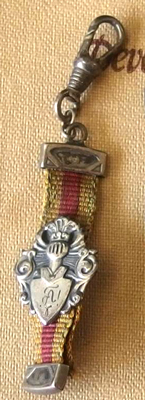
The item in the image appears to be a small decorative medal or charm featuring a knight's helmet above a shield with the letter "H" on it, attached to a red and yellow striped ribbon with a clasp at the top.
Based on its design elements, it likely represents a fraternal, heraldic, or commemorative piece rather than a formal military decoration. The knight helmet and shield motif are common in heraldry and fraternal organizations, symbolizing honor, protection, and chivalry.
Without more specific markings or context, it is difficult to identify the exact origin or purpose, but it is probably a collectible or symbolic medal related to a group or event that uses medieval or knightly imagery.
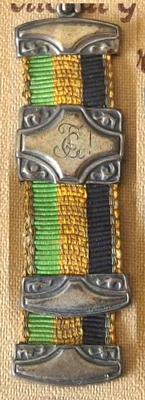
The item in the image is a small decorative medal or ribbon bar with a green, yellow, and black striped ribbon and silver clasps. The central clasp has the letters "EC" engraved on it.
Based on the design and the letters, it appears to be a fraternal or commemorative medal rather than a formal military decoration. The colors and style do not directly match common U.S. military ribbons or widely recognized international military awards.
Without additional context or markings, it is likely a collectible or symbolic medal related to a specific organization, event, or group that uses these colors and the "EC" initials. It may be associated with a fraternal order, club, or a commemorative piece rather than official military service.
This image showcases a gold-toned antique badge from the "Brotherhood of America," featuring an elaborate design, including a torch and radiating starbursts.
patriotic emblem with an eagle perched above a shield decorated with stars and stripes, and the text "USA" and "ALL THE WAY." This type of pin is typically a patriotic symbol used to express support for the United States, often worn during wartime or patriotic events.
In summary, these are vintage patriotic and fraternal organization pins/medals symbolizing American unity, patriotism, and possibly membership or support for specific groups or causes related to American heritage.
Pathfinder Badge of the United States military.
The badge features a gold torch with a red flame and a wing extending from the torch.
The wing symbolizes flight and airborne capabilities.
The torch represents leadership and guidance, implying pathfinder combat skills.
This badge is awarded to soldiers who have completed the Pathfinder School, which trains personnel in navigation, air traffic control, and establishing drop zones and landing zones for airborne operations. It signifies expertise in leading and guiding airborne and air assault operations.
Parachutist Badge, commonly known as "Jump Wings," of the United States Armed Forces.
It features a parachute flanked by outstretched wings.
This badge is awarded to military personnel who have completed the required parachute training and qualified parachute jumps.
It symbolizes airborne qualification and the ability to conduct parachute operations.
The Parachutist Badge is a recognized symbol of airborne forces and is worn by members of the Army, Navy, Marine Corps, and Air Force who have earned parachutist status.
1
2
3 ?? Vietnam Service Medal Ribbon Details
Awarded to: U.S. military personnel who served in Vietnam, Thailand, Laos, or Cambodia during the Vietnam War.
Colors and symbolism:
Yellow with red stripes: Represents the South Vietnamese flag.
Green edges: Symbolize the Vietnamese jungles.
Eligibility period: Service between July 4, 1965, and March 28, 1973.
Devices: Bronze service stars may be attached to denote participation in specific campaigns.
4
5
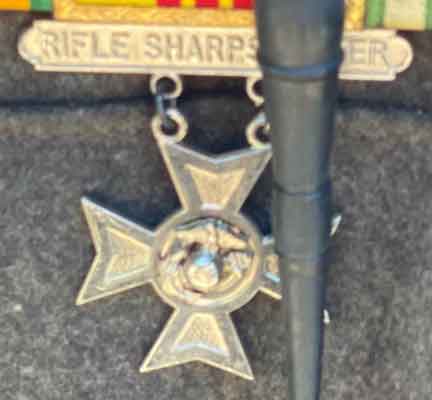
The medal in the image is a United States Marine Corps (USMC) Rifle Sharpshooter Badge.
The badge features a Maltese cross with the Marine Corps emblem (Eagle, Globe, and Anchor) in the center.
Above the medal is a bar inscribed with "RIFLE SHARPSHOOTER," indicating the qualification level.
This badge is awarded to Marines who achieve a sharpshooter score on the rifle qualification test, which is a mark of proficiency in rifle marksmanship above the basic marksman level but below expert.